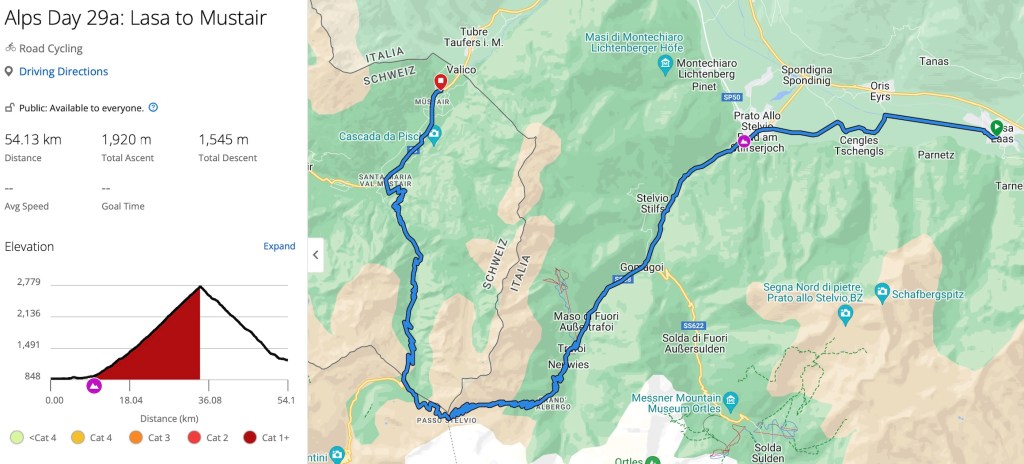
Day 29 (1st September) – Part A: Lasa to Mustair.
First day of spring. Clear skies again after a cracking overnight storm. A sliver of a moon hangs low over the mountains to the east. I check my What’sApp. Jack, my son, has sent me a wish for a good father’s day.
The signs were indeed good for an auspicious day of cycling – today we rode over one of the iconic climbs of the Alps – Passo dello Stelvio.
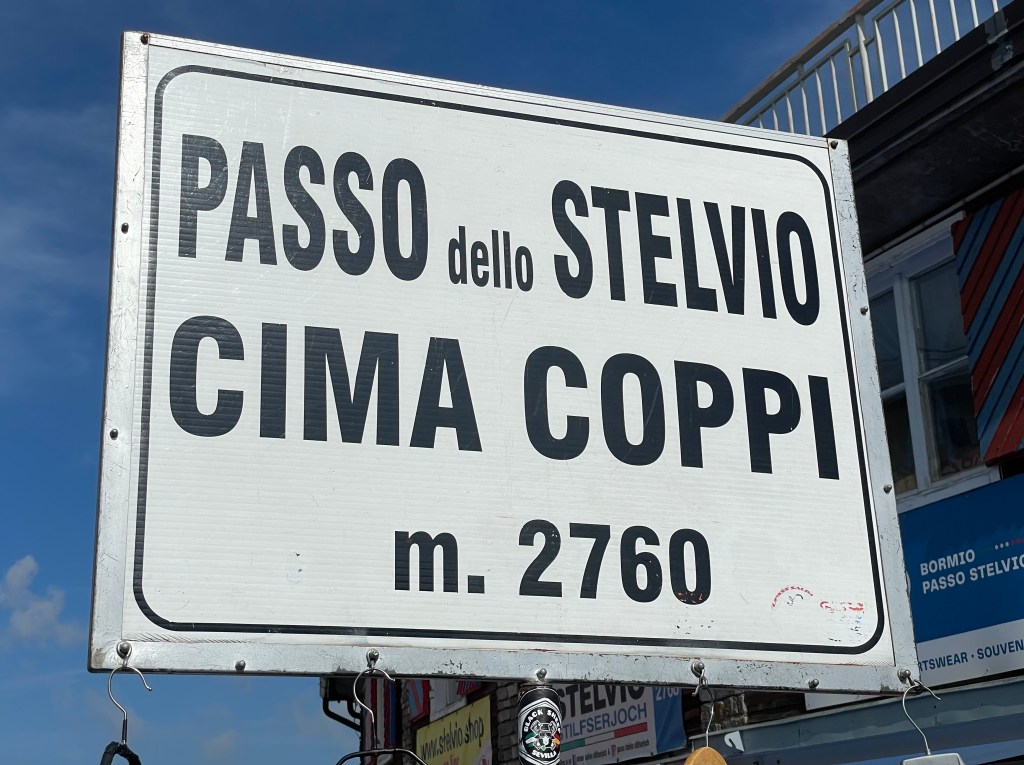
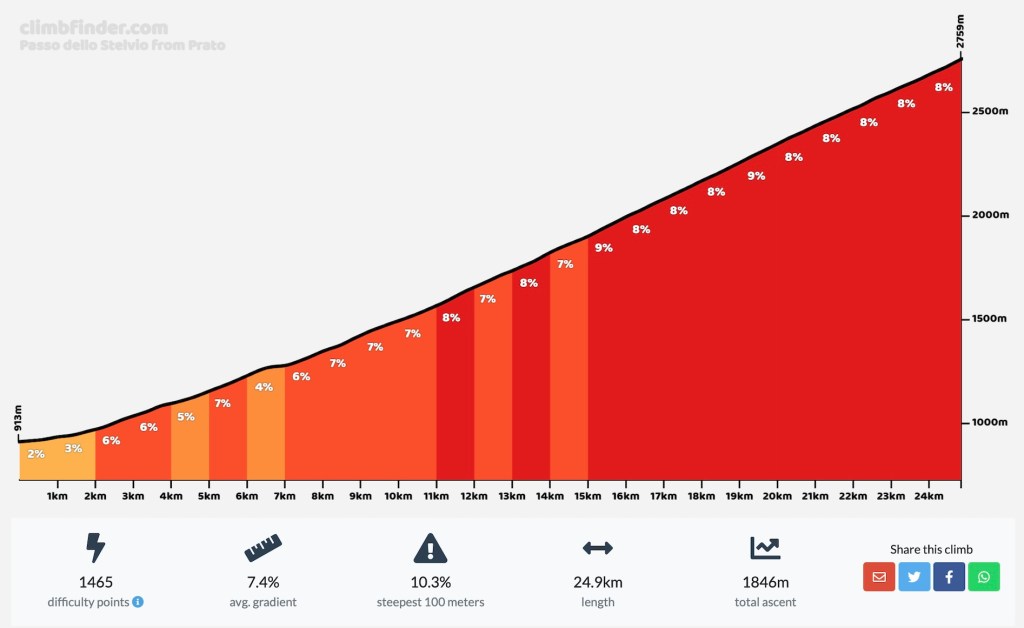
The Stelvio Pass is the second highest paved mountain pass in Europe featuring 48 numbered tornante (hairpin turns) on its northern face.
The road was built between 1820-1825 to connect the Austro-Hungarian Empire with Lombardy and maintain communication and control over those troublesome Italian rebels agitating for the unification of their own country.
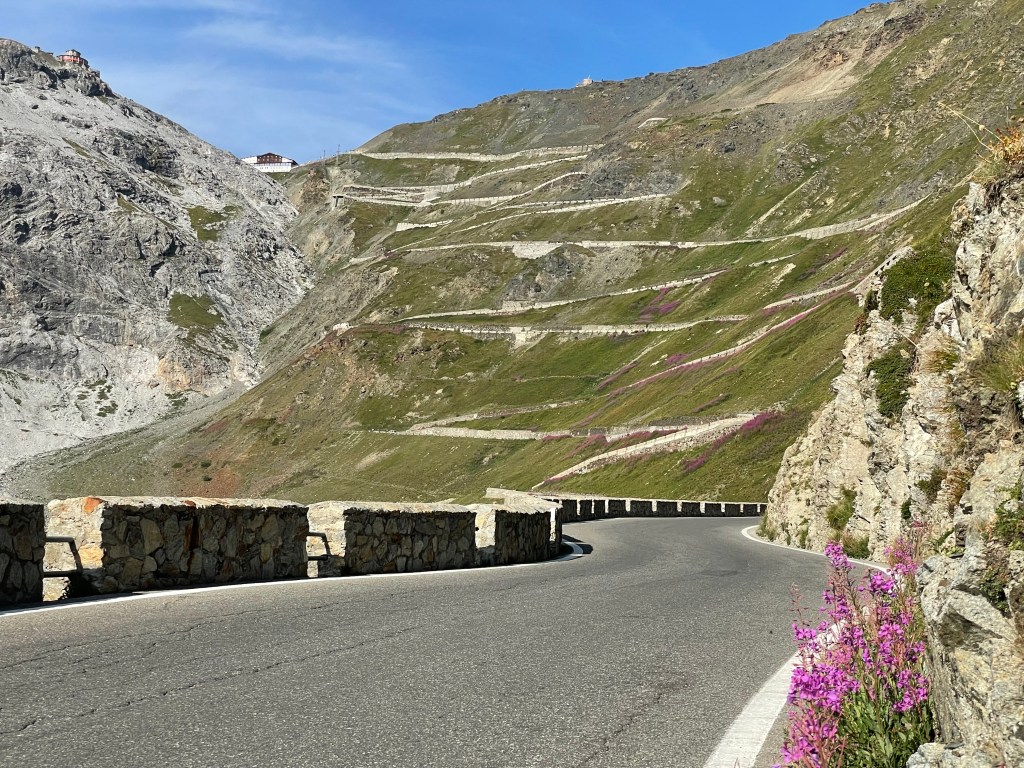
Overseen by Carlo Donegani, an expert in high mountain engineering – it employed over 2,500 workers, engineers, and geologists – a remarkable feat of engineering for its time.
Today, it’s a popular route and destination for sports car and motor-bike enthusiasts from all over Europe.
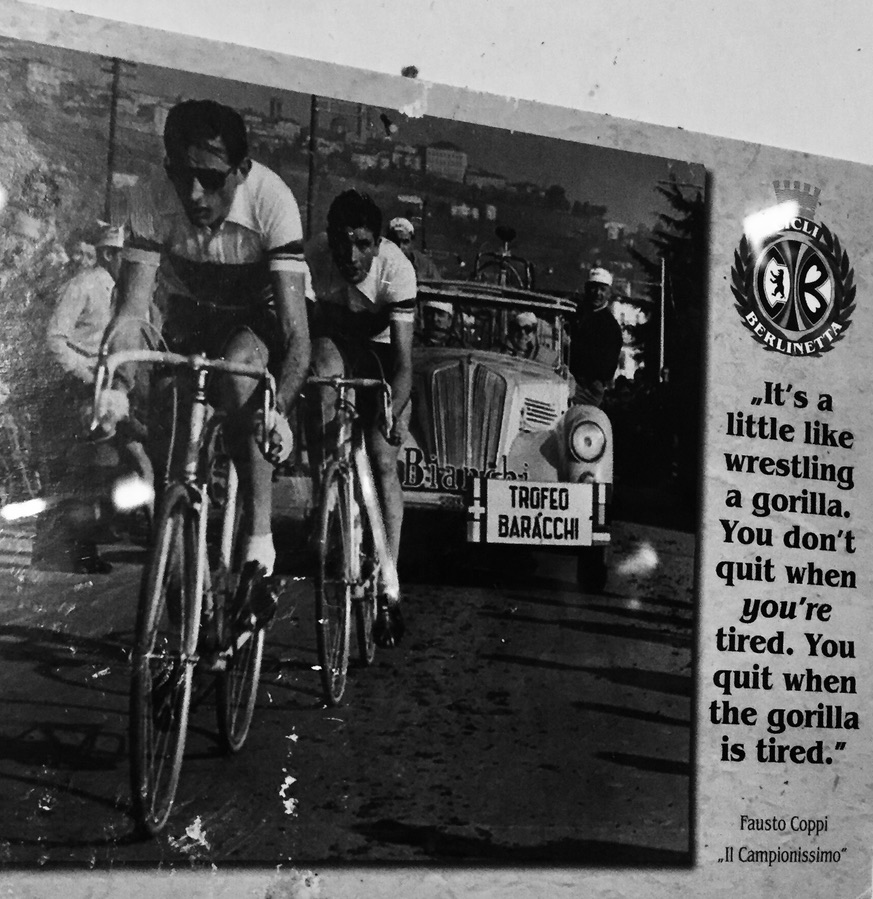
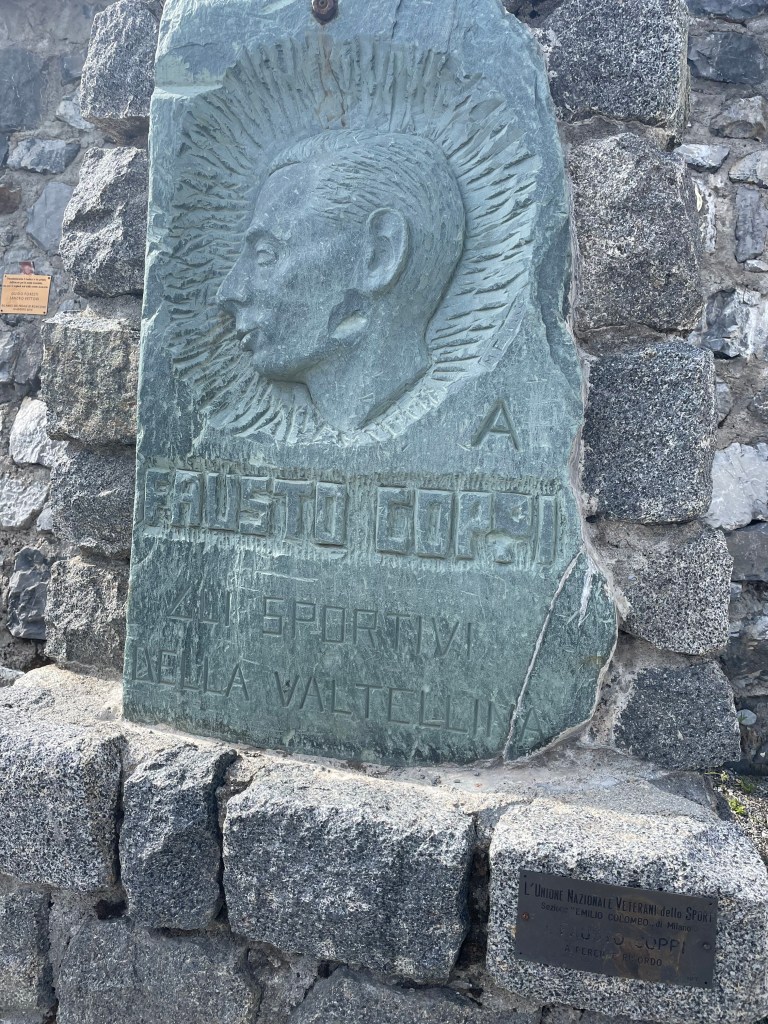
The Pass also draws thousands of cyclists, and is often featured in the Giro d’Italia bike race. Legendary cyclists like Fausto Coppi have cemented their status with memorable performances on this climb.
Australian Jai Hindley cemented his name into folklore when in 2020, he climbed the pass in a record 1 hr 10 min and went on to win the Giro. His average speed was 20.3 km/hr over an average gradient of 7.7% and 1568m elevation gain. (Given that I’m nearly 3 times his age when he won, I think it only reasonable that I took nearly 3 times as long – including for photo stops!)
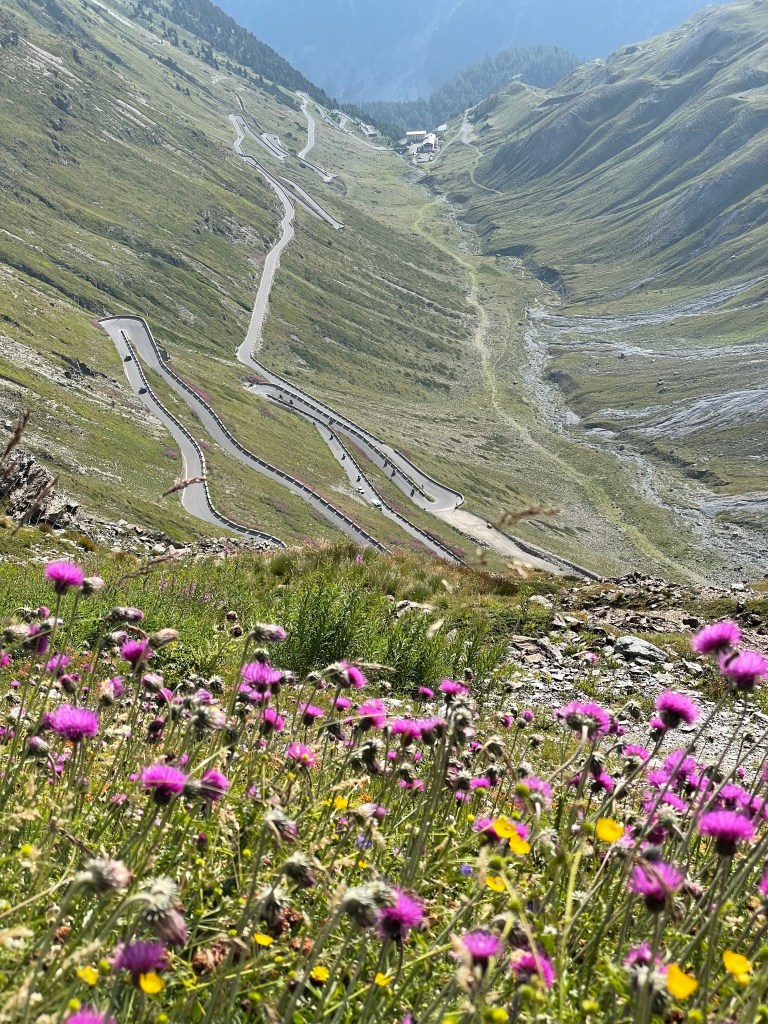
At first the climb was relatively quiet and meditative, through coniferous forest on the lower slopes, opening out to grand views of the Ortler Alps.
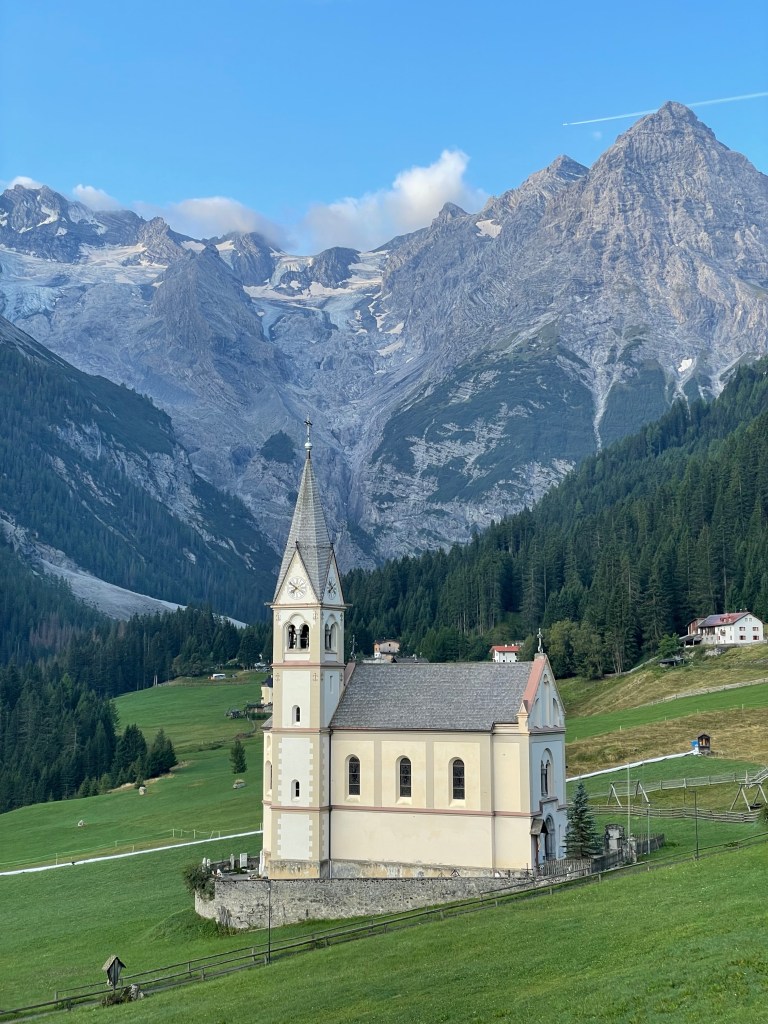
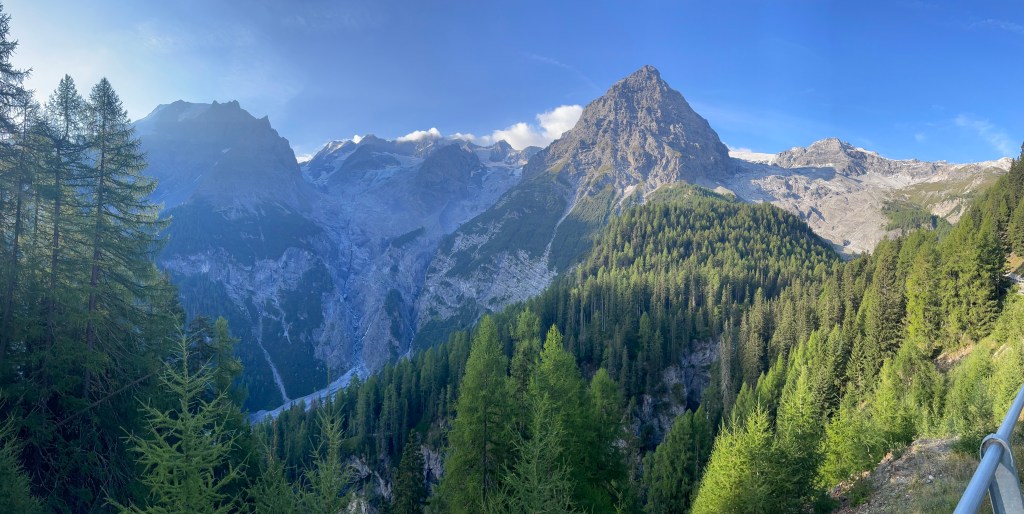
As I was switching back and forth between tornante, immersed in the silence, I started to ponder how, these days in cycling, there are all sorts of whizz-fang feedback devices like heart-rate monitors and power-meters to keep you focused on optimum performance.
I decided that I like to keep it simple by asking myself 3 basic questions:
- How is my breathing – steady or laboured? When it’s steady, I know I can sustain the effort to climb.
- Where is my weight – in the saddle or upper body? When I’m in the saddle or in my core, I’m relaxed in my upper body and my shoulders aren’t tense or hunched.
- Am I pedalling or pushing? By the time I get to this question, I am usually pedalling as if by instinct…
At about 9am, as if on cue, my grey matter perambulations and ratiocination was interrupted by the first of an endless parade of hotted up sports cars and motorbikes with sawn-off mufflers blasting up the mountain.
Fortunately, they tended to come in waves. In between, I could enjoy moments of peace and take in the soothing sounds of cow-bells, marmots and distant waterfalls and cascades tumbling from melting glaciers.
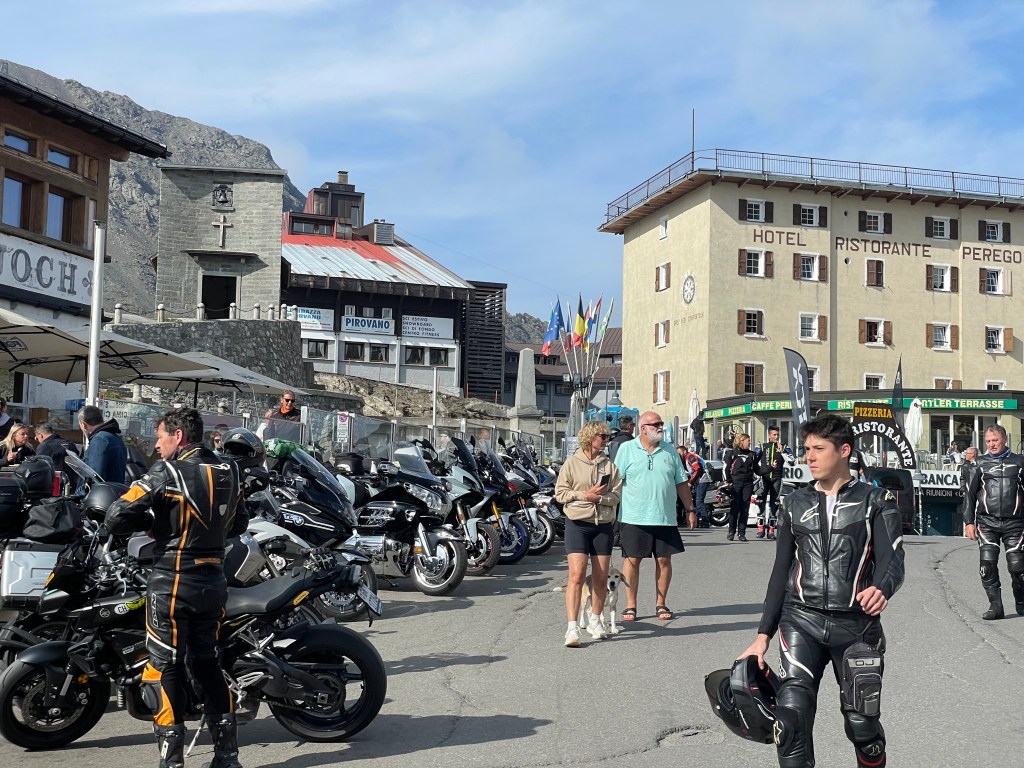
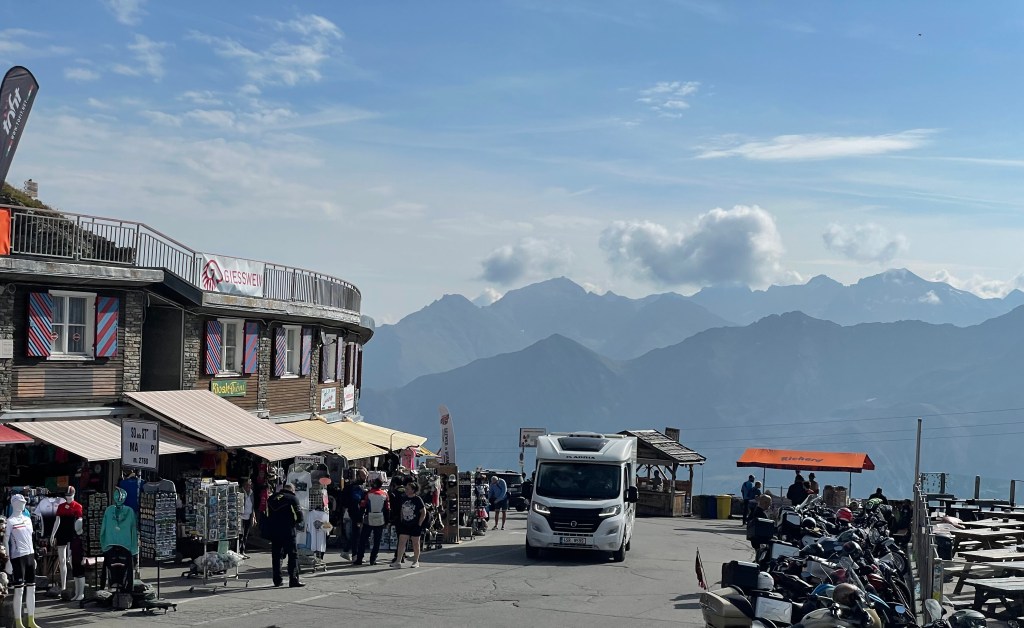
At the Pass though, it was a complete circus. A noisy traffic jam of cars and motor bikes among scores of souvenir stands, a few restaurants and hotdog stands. We didn’t stay long.
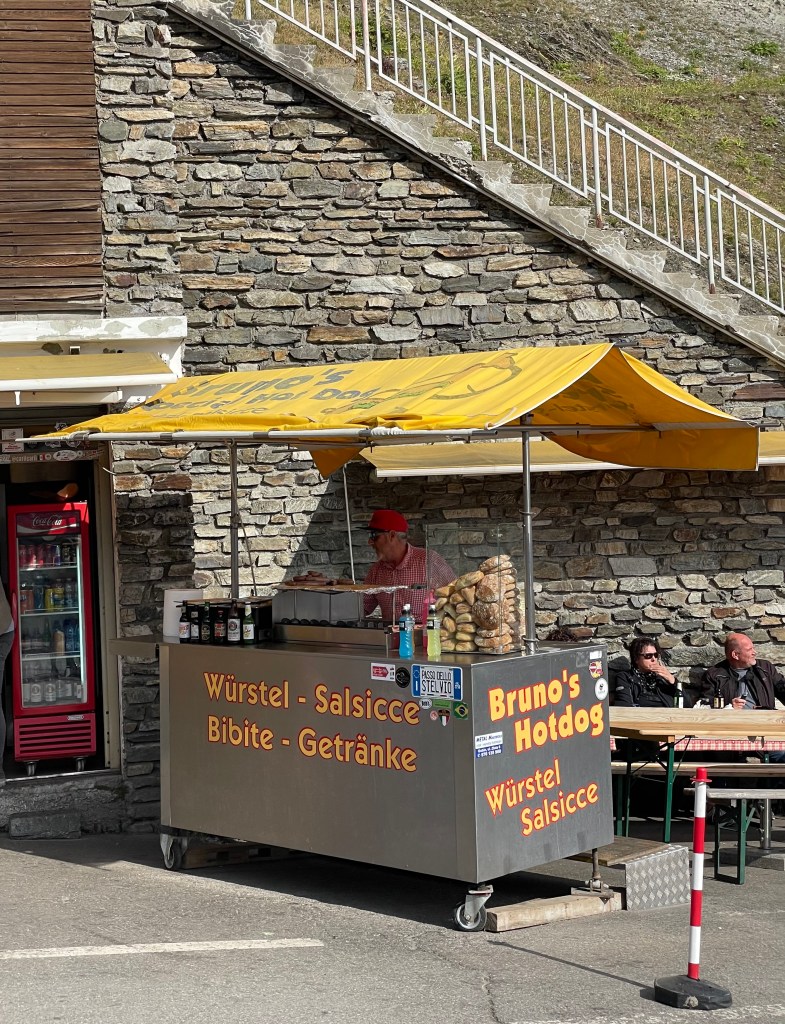
After leaving the spectacle at the pass, we made our way down another set of exciting switchbacks into Switzerland via Umbrail Pass to meet up with Sue and Liz who were waiting for us in Mustair opposite the Abbey of Saint John.
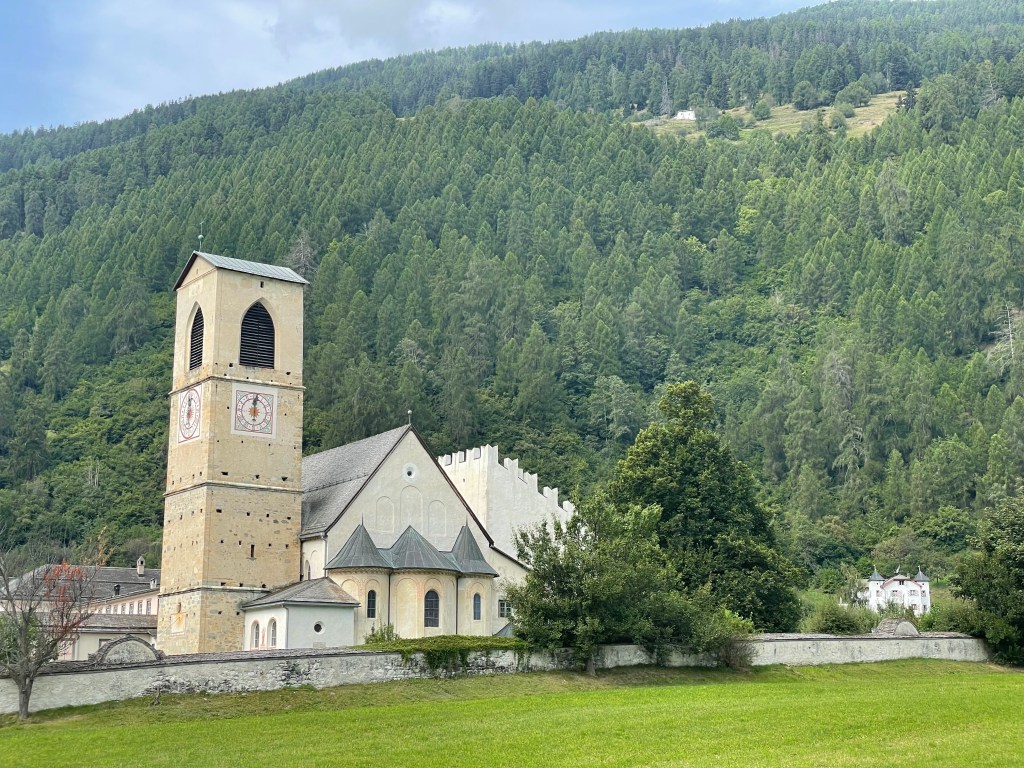
An early medieval Benedictine monastery supposedly founded around 775 CE by Charlemagne, it is now a UNESCO World Heritage Site due to its exceptional preservation of Carolingian art. Legend has it that Charlemagne established the abbey after surviving a snowstorm at the Umbrail Pass.
According to Garmin


 By Bike
Leave a comment